
Understanding shouldn’t be something you rent.
We’re five friends building the foundation that lets a company’s AI understand how it works, and lets the company keep that understanding as its own.
How we found each other.
We met partly during our studies, partly through the German Academic Scholarship Foundation. Countless conversations and a few detours later, we all ended up at knowledge graphs. Four of us grew up in Baden-Württemberg, Ansel in Singapore, but all of us feel a strong bond with the region. We want to show that state-of-the-art technology doesn't have to come from the US alone, and that commercial and technical thinking can come together here too.
A construction industry where no one has to guess whether a drawing still holds.
A decision made once, with real expertise, isn't lost the moment a project moves to the next phase. It travels with the project, sourced and findable for as long as it applies. We don't believe in software that decides what's right. We believe in software that overlooks nothing, so the person who carries the responsibility can carry it with the full picture.
We give German architecture and engineering firms a platform that fully understands their project.
Every drawing, every model, every minute, every email, and on top of it workflows that answer the questions that cost days today.
The right moment, not just the right idea.
- The pressure
- Design offices are under pressure: more regulation, fewer people, and the liability stays with the engineer. AI only helps if it knows the project instead of guessing it.
- The moment
- Language models have only recently become good enough to propose the meaning an needs. What used to be a consulting project over years can now be a product an office can afford.
- The sovereignty
- And the data stays where it is. Nothing is migrated, nothing uploaded. Processing runs on our own infrastructure in Germany.
The people behind it.
The pressure on design offices is real, language models have reached the right moment, and the infrastructure stays in Germany. The people turning that into a product: engineers, and the commercial minds beside them, who would rather get the meaning right than ship a clever guess.
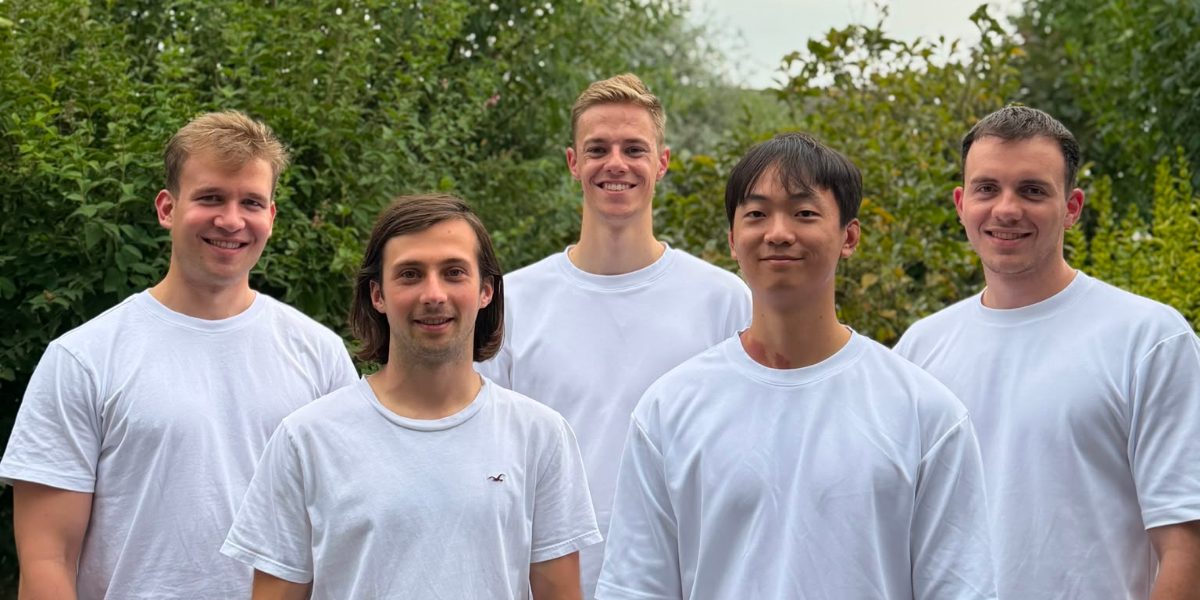
Banking and finance at the University of St. Gallen, with stations in Singapore and Madrid. At Folaint he runs finances, the financial model and investor relations.
Simulation technology at the University of Stuttgart. At Folaint he runs the infrastructure nobody sees: servers, Linux, databases.
Machine learning at the University of Tübingen, before that simulation technology in Stuttgart. Has worked with knowledge graphs in research and in industry. At Folaint he builds the layer that connects documents, models and rules.
Data science at the National University of Singapore, then machine-learning engineer at a cybersecurity company there. At Folaint he is responsible for ML engineering and data architecture. Based in Tübingen.
Three years of a dual-study programme at an international financier of information, medical and industrial technology, then a year full-time there in corporate strategy and M&A. At Folaint he is responsible for market and strategy.
The principles we build by.
Your project knowledge stays yours
Contracts, minutes, drawings and standards stay in open formats on European infrastructure. What we build on them is yours to keep, with or without us.
The engineer decides, not the model
Folaint lays out findings and contradictions: here are two rules, here is where they clash. Which one governs is your call, and it is recorded with your name on it.
Every finding names its source
Contract, minutes, drawing or standard, down to the page. Not because it looks thorough, but because in a dispute an answer without a source is worth nothing.
Built in Europe, under EU rules.
We believe in a strong Europe that builds its own AI instead of buying it. The engineering firms here have built up knowledge over decades that no other market holds this densely. That knowledge should be able to work with AI without leaving the continent. So Folaint runs on European infrastructure, under the rules that apply here. We do not see that as a hurdle. We see it as the ground on which trust is built.
Baden-Württemberg, Germany