Made in Baden-Württemberg
Every hour spent reconciling documents is an hour your project does not move forward.
We connect what nothing else brings together: today's BIM model, the formwork drawing, the structural calculation from 1968, and the consent behind it. Every answer traceable to the page it came from.
The structure is a system. The paperwork is a pile.
Uploading is not enough. What your best engineer knows is in no file.
The structure
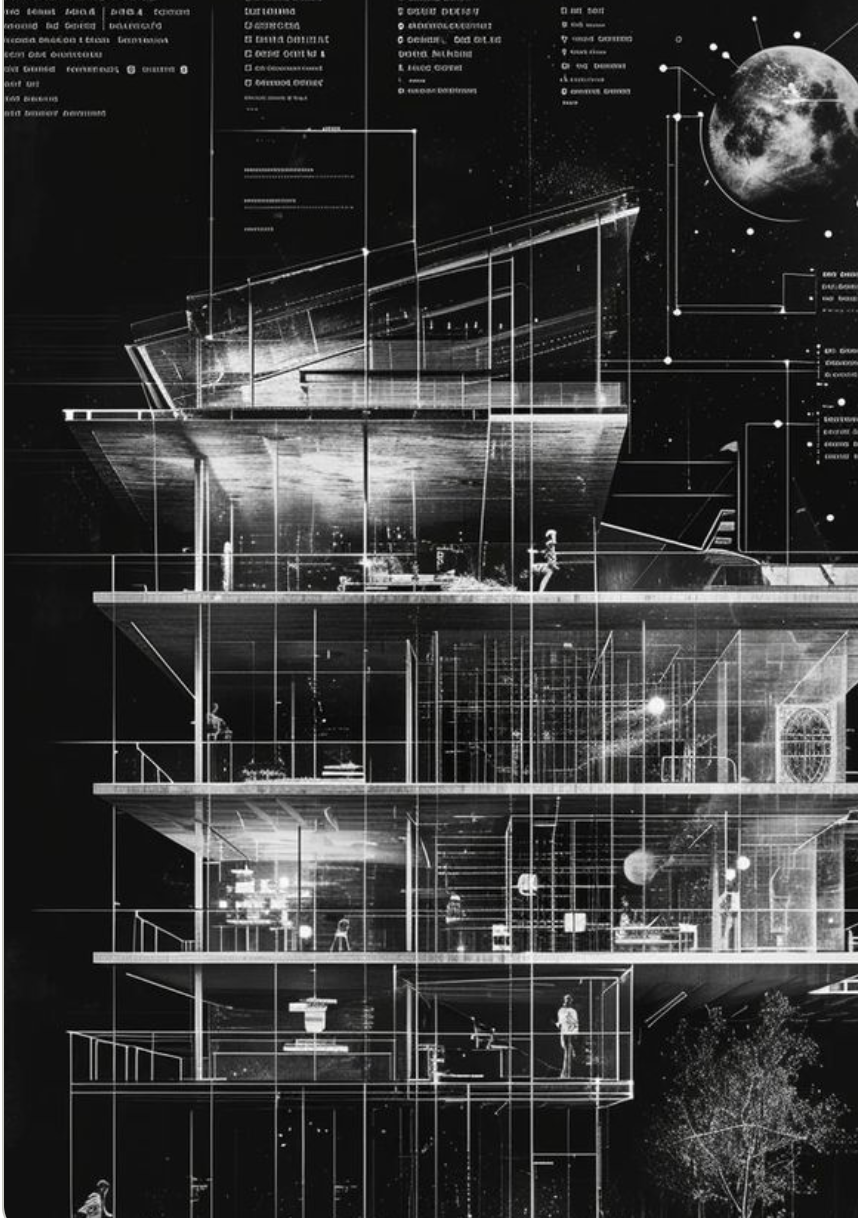
An engineering structure is never finished. Work on it runs for decades.
Designed, consented, built, inspected, reassessed, strengthened: every stage leaves records the next one needs. The structure outlasts them all, and every career that has looked after it.
The paperwork
Project folder · Neckar bridge BW 42, replacement structure
10 files
No links · no file knows about any other
Everything in one folder, everything into the AI, and still nothing is connected.
Every file describes the same structure, and no file knows about any other. So an AI reads them one at a time and never works out which requirement governs which element. The value only appears once all of them are brought together and understood: exactly the work a person does today, over many hours of reading and cross-referencing.
Without the connections, the AI is guessing. It just does not say so.
Capacity
Take on the projects you have to turn down today
You cannot find engineers. But a serious share of the day of the ones you have goes on hunting things down: the original structural calculation for a given element, the condition buried in the planning consent, where things stood in the last design team minutes. Across all your live projects that is the legwork the assistant takes over. The judgement stays with the engineer.
Fees
You earn your fee at the front end
More than half the fee is earned before detailed design begins, in preliminary design, design development and consent. That is exactly where the searching happens: through options, past projects, consent documents. Every hour that goes into it is already paid for and lost all the same.
Evidence
Still defensible in twenty years
Conditions attached to a planning consent bind you beyond the construction period, in some cases for decades, and expressly bind whoever takes the project over. Today somebody settles on the phone why something was built the way it was, and the outcome lives in an email. With Folaint it hangs on the element, with its reasoning and its date.

When a colleague leaves, their knowledge stays
Your practice already holds the knowledge, just not where you need it. It walks out with every move and every retirement. We turn it into an asset the practice owns.
We have spoken with a lot of engineers. The same thing comes up every time: years of training, years on the job, and the afternoon disappears into a stack of paper and email attachments.
The questions that cost hours today.
Not because they are hard. Because the answer is spread across documents that know nothing about each other. A single tool reads each document on its own. It answers none of these questions, because what it is missing is the connection between them.
- Am I working from the current revision or a superseded one?
- Which condition of the planning consent applies to this element?
- Does the state before the revision apply here, or the one after?
- Where does this variation depart from the original contract?
- Is this extra work covered by the fee or is it chargeable?
- Which requirement governs when the ZTV-ING and the Eurocode size the same element differently?
- Does the inspection report still match the revised detailed design?
- Which condition is still open, and who worked on it last?
- What do I show later to prove this ruling was made this way?
- What does the original structural calculation say about this element?
- Do the quantities still match the revised model?
- How did the practice solve this on the last comparable structure?
That connection is what we build. Every answer traceable to the page it came from.
The same folder. Now every file knows about the others.
No magic and no black box: three stages that turn exactly this folder into a graph. Every connection in it stays traceable back to its source.
Where it comes from
Contracts, drawings, minutes, emails, approvals, certificates: Folaint reads the storage you already have, where it already sits. No migration, no new system, no pipeline you would have to build first.
What we read out of it
From every document we read out not only the rules that actually apply, but the relationships between them, including the implicit ones, written down nowhere: which standard, which contract, which ruling belongs to which building element. Checked against your own standards, not against a generic dataset.
What it becomes
The rules become a structure you can ask questions of. Every point carries:
That is the graph: on top of it, agents understand any task the way an experienced project lead does.
Date
since when it applies
Source
which document it came from
People
who decided it
Links
how it connects to the rest of the network
Before
Project folder · Neckar bridge BW 42, replacement structure
10 files
No links · no file knows about any other
Ten files, ten islands.
The folder tells you when each file last changed. It does not tell you which change made another file wrong.
After
The same ten, now with relationships.
Not a single file has been added, only the connections: the detailed drawing contradicts the model, and the ZTV-ING demands more than the Eurocode.
That is the first layer: everything from your documents, connected.
What is written down nowhere, you decide once.
After that it lives in the project: every further answer knows your ruling. Processing happens in Germany, and in your own environment if you want it there. It never flows into someone else's model.
What concrete cover applies to the superstructure, and which requirement governs?
Superstructure, axes 20 to 40 · edge beam in the spray zone
The tender documents put the superstructure in exposure class XC4.
For XC4 the Eurocode with its National Annex gives a nominal cover of 40 mm. Read off the formwork drawing itself: 40 mm.
Requirement metDIN EN 1992-1-1/NA · tab. 4.4
Sounds right. It is right. It is just not complete.
Read the formwork drawing: superstructure, axes 20 to 40
Searched all documents for “concrete cover” and “exposure class”
Picked the closest match: Eurocode 2 with National Annex
Derived the nominal cover for XC4 and compared it against the drawing
Done
This is where it went wrong: the closest match, not every rule that applies.
The edge beam sits in the spray zone of the carriageway. That makes it XD3, and the ZTV-ING allowance is counted on top.
Added by the structural engineer
Exactly the sentence that otherwise only lives in the engineer's head.
And from now on the project knows it.
It is not a model on someone else's server that learns. Your project does. And what comes of it stays in Germany.
Same question. Same drawing. Different answer.
What concrete cover applies to the superstructure, and which requirement governs?
Superstructure, axes 20 to 40 · edge beam in the spray zone
Read the formwork drawing: superstructure, axes 20 to 40
Determined the exposure classes: XC4 AND XD3
Pulled every applicable requirement, not just the closest match
Aligned the reference quantities: minimum cover, allowance, nominal cover
Identified the strictest requirement: ZTV-ING part 3
Compared against the formwork drawing
Done
Three requirements apply. They calculate over different reference quantities and are only comparable once converted.
Converted to nominal cover, the ZTV-ING governs at 50 mm. Read off the formwork drawing: 40 mm.
Requirement not met10 mm shortZTV-ING part 3 · cl. 4
Built with too little cover means the reinforcement sits too close to the surface, and nobody finds out until the superstructure has been poured.
And next time, nobody has to ask.
And this is the second: everything that is in none of them.
Put the two together and you have the answer. Right where you already work.
Folaint brings no interface your team would have to learn: no new system, no second screen to master. Your engineers carry on where they are and, at first glance, notice nothing of the layer behind it. You ask the question in the tool that is already open. What comes back carries its evidence with it, and every piece of it leads back into the two layers underneath.
The connected project knowledge
Files, models and standards: linked instead of stacked.
Your rulings
What is in no document, said once and binding from then on.
The foundation
MCP, or another interface you already have
Through one interface. No new tool, no second screen.
Ask something from one of the work stages below …
Your AI applications stay. What is new is the layer beneath your data.

How we start.
No rollout over months, and no project that shows its first result a year from now. We start with a single question.
We start small, but on the hardest case. Only what holds up there is reliable.
Your most expensive question
You name the question that regularly costs someone in your office half a day: the one where four documents get laid out side by side to arrive at a single number. Not the easiest one. The one whose answer eats the most time.
- Your real case, your real documents
- No demo data, no sample project
- What it costs you today is the benchmark
Proof of concept
We model the slice of the rulebook that this one question needs, and answer it on your documents. You hold the result against what your own people work out by hand, and you can see for every statement where it came from.
- Every answer evidenced down to the source
- Checked against your own result
- Tightly scoped, unambiguous outcome
Next question, or rollout
Then you decide whether the next question joins it or the whole project goes live. Both continue on the same graph: whatever has been modelled once is already there for the next question.
- Every question extends the same structure
- Nothing gets rebuilt for the next case
- The marginal cost per question falls
A tool is exactly as clever after the tenth project as it was after the first. A graph is not: every question answered stays in the project memory and carries the next one.
What we get asked.
The questions design practices put to us regularly, answered here in advance.
What makes your technology different?
Two building blocks. First an ontology: a fixed model of what exists in a construction project at all (building elements, rooms, rulings, deadlines, trades, the people involved), and which relationships between them are permissible. Second a graph database that stores your project knowledge in exactly that shape: not as blocks of text, but as named points with named connections. What separates this from a language model on its own is the obligation to a form. A model without an ontology has no rule about what belongs together, so it answers plausibly. With an ontology it is fixed that a ruling without a date, a source and an author is not a ruling. Every answer can therefore be traced back to those details. When they are missing, you see it immediately instead of merely suspecting it. That is why ontologies start to matter the moment AI has to be reliable rather than just eloquent. Which language model runs underneath is deliberately interchangeable: our layer is the ontology and the graph, not the model. That comes from an AI provider of your choice.
How is this different from ordinary AI search across our documents?
The usual build breaks documents into snippets and fetches the most similar ones. That works as long as the answer sits inside a single snippet. Your questions are usually multi-step: which standard applies to this room, was the ruling on it changed later, and does that change affect the trade going out to tender next week? Similarity search finds three passages that know nothing about each other. The graph walks the path instead: from the room to the ruling, from the ruling to the change, from the change to the affected trade. And it can show each step separately. In published comparisons, graph-based methods lead vector search clearly on exactly this kind of chained question. On simple lookups there is little in it. So we use both, with the structure leading.
We already use SIB-Bauwerke for structure inspections. What does this add?
Nothing to condition recording. Which defect sits on which element and what condition rating follows from it is something your system handles reliably, and we have no intention of improving on that. The point is that condition is only one of several statements about the same element. Three others sit beside it, and none of them lives in a field: what the planning consent imposes at that location. What the original structural calculation says about the reinforcement. What the last design team meeting ruled on it. None of the three is a condition record, and all three are decided between an element and a text. That is where we work: not condition against condition, but the element against what the consents, calculations and minutes say about it.
Our as-built records are scans, some of them on microfilm. Does this help at all?
Especially then. A structure from the sixties comes with its original structural calculation, formwork drawings, a structure record book and thirty years of inspection reports, and most of that is paper, scans or prose. Which reinforcement sits where, which condition from which consent still applies, which repair was carried out when and why: that is written in sentences and drawings, not in fields. Which is precisely why no model-checking tool touches it: they all assume a cleanly classified model, and for this structure one never existed. We read both and hang them on the same element: the statement from the consent and the cross-section from the drawing. Where a scan is no longer legible, we say so instead of guessing. What stands out we put forward as a candidate. Your specialist engineer decides.
Who is liable if Folaint misses something?
You are. Folaint changes nothing about that. This is not a contract clause but the legal position: design services are owed as a work contract. Whoever releases a result is answerable for it, regardless of whether a person or a machine made the mistake. Which is exactly why Folaint is built to decide nothing and release nothing. It puts things forward: here is a contradiction, here are the two documents, here are the passages. What changes is how complete the check is and how long it takes. Who signs at the end does not change.
How can I trace where an answer came from?
Because the graph holds not only what applies but where we got it. Every connection carries which document it was read from, at which point in that document, with which date, and in which processing step it came about. On top of that there are two timelines: when something applied in the project, and when we learned about it. That answers the question actually asked in a dispute: what was known at that point in time? So an answer here is not running text but a path across evidenced points. Every single connection in it can be traced back to its source. That is the proof itself, not a note claiming there is one.
What about data protection, hosting and security?
Processing is GDPR-compliant in data centres in Germany, on the basis of a data processing agreement under Art. 28 GDPR. Your project data is not used to train models, neither by us nor by third parties. Where the client or your own policy requires it, operation in your own environment is possible; that comes up regularly on public projects and is therefore designed in from the start. ISO 27001 certification is in preparation and firmly on the roadmap. We deliberately do not write that we already hold it.
Do we have to introduce a new tool or reorganise our filing?
No. Folaint is not another tool beside your tools, it is the layer beneath them. It reads what your project produces anyway: folders, emails, drawings, minutes, contracts and, where one exists, a BIM model, and it reads them where they already sit. Nobody has to rename files, copy them into a new system or change format. A complete BIM setup is explicitly not a prerequisite: what most practices actually hold is mostly 2D and spreadsheets. That is precisely where Folaint starts. And we do not start with the whole practice, but with one process.
Are you already working with design practices?
Yes. We are in a pilot with a multidisciplinary practice, on real project data, not a demo set. The scope is deliberately tight: one process where it can be measured whether the answers are right and whether the time saved actually shows up in the working day. Further pilots are being prepared. We name names only once our partners release them; in conversation we can say more about the setup and what we have learned.
What does it cost?
Two parts, because two different things take work. Once at the start: bringing the ontology onto your practice: your trades, your document types, your naming, the logic of your filing. That is the step that turns your existing storage into a graph you can rely on. It is setup, not a licence fee. Then ongoing: keeping the graph current while the project runs, so every new ruling, every design change, every variation. Actual figures depend on project size and data volume, which is why they belong in a conversation rather than on a price list.
Your question is not here?
Ask us
Let us bring your project knowledge together.
One process from one of your projects, worked through end to end. After that you can see what a connected structure does for you.
Arrange a conversation